See the foundations behind your next lesson.
ManySpace helps you choose a starting point in mathematics, physics and AI/ML. Its map connects topics through prerequisite links, so you can inspect what a goal builds on and follow your own progress.
How it decides
-
0%25%50%75%100%
Mastery is light
Mastery is an estimate built from recorded study, practice and review evidence, including self-checks. It is not a qualification or an independent assessment.
-
Reviews follow memory
The FSRS memory model schedules reviews using your answers and chosen retention target. A target is not a guarantee of recall.
-
Prerequisites gate
The prerequisite graph connects your goal to its foundations. The roadmap uses those links and your progress to show what is unlocked.
-
Practice aims at 75%
Where generated practice exists, the engine grades answers and adjusts difficulty. It aims for about 75% success; results vary by learner and topic.
What is finished, and what is not
Included
- Every topic has a captioned lesson film.
- Some topics also have a deeper interactive lesson.
- Generated practice exists for selected topics.
- Lessons, captions and controls are in English.
Not included
- There is no narration.
- There is no live tutoring.
- Films were made with AI assistance and not all have been reviewed end to end by a subject expert.
Part of Aporia Systems
ManySpace is an Aporia Systems project developed by Yunus Emre Vurgun and Yusuf Ceylan. Questions and corrections can be sent to [email protected]. Find the other projects at aporia.systems.
Contact the teamCredits
- Milky Way backdrop: NASA/Goddard Space Flight Center Scientific Visualization Studio, Deep Star Maps 2020, from ESA Gaia DR2 data. NASA SVS 4851
- Review scheduling: the FSRS algorithm by the Open Spaced Repetition
- Math rendering by KaTeX; 3D by three.js; charts and tools are plain JavaScript.
- Planet, moon, spacecraft and sky photographs: public domain images from NASA missions and partners:
- Earth from Apollo 17, 1972 NASA / Apollo 17 crew
- The Moon, Lunar Reconnaissance Orbiter mosaic NASA / GSFC / Arizona State University
- Mercury, MESSENGER NASA / JHU APL / Carnegie Institution of Washington
- Mars and Valles Marineris, Viking orbiters NASA / USGS
- Jupiter, Hubble Space Telescope NASA, ESA, A. Simon (GSFC)
- Saturn at equinox, Cassini NASA / JPL / Space Science Institute
- Uranus, Voyager 2 NASA / JPL-Caltech
- Neptune, Voyager 2 NASA / JPL
- Pluto, New Horizons NASA / JHU APL / SwRI
- Charon, New Horizons NASA / JHU APL / SwRI
- Io, Galileo NASA / JPL / University of Arizona
- Europa, Galileo NASA / JPL / DLR
- Ganymede, Galileo NASA / JPL
- Callisto, Galileo NASA / JPL / DLR
- Titan, Cassini NASA / JPL-Caltech / Space Science Institute
- Enceladus, Cassini NASA / JPL / Space Science Institute
- Ceres, Dawn NASA / JPL-Caltech / UCLA / MPS / DLR / IDA
- Bruce McCandless II on the first untethered spacewalk, STS-41-B, 1984 NASA
- The International Space Station after STS-132 NASA / Crew of STS-132
- Aurora australis from the International Space Station NASA / ISS Expedition 23 crew
- The Orion Nebula, Hubble NASA, ESA, M. Robberto (STScI/ESA) and the Hubble Orion Treasury Project Team
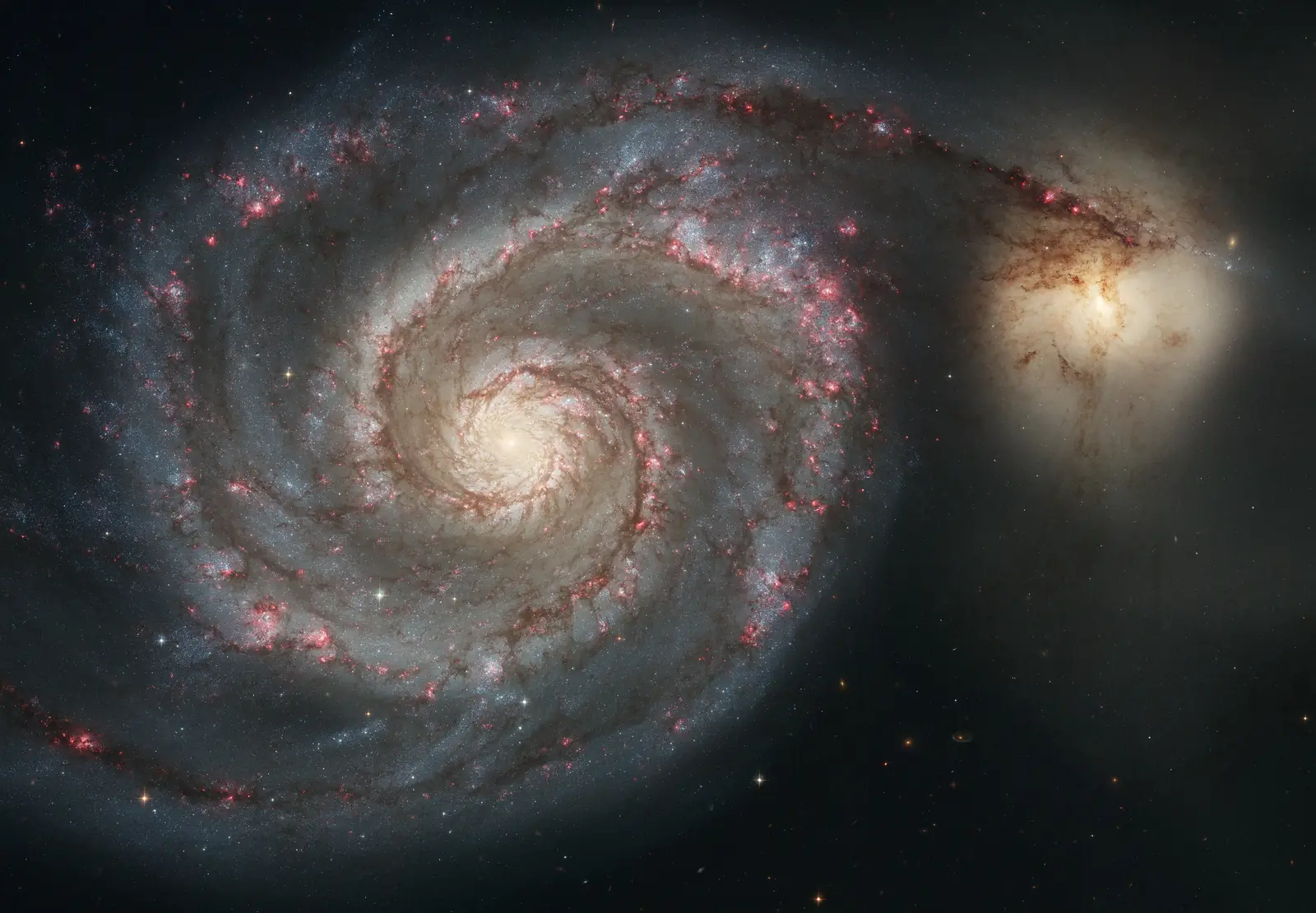
- The Whirlpool Galaxy (M51), Hubble NASA, ESA, S. Beckwith (STScI) and the Hubble Heritage Team
- The Hubble Ultra Deep Field NASA, ESA, S. Beckwith (STScI) and the HUDF Team
- Earthrise, Apollo 8, 1968 NASA / Bill Anders


