
What to learn before calculus, step by step
Before Calculus I, learn arithmetic, algebra, trigonometry and precalculus, in that order. On the ManySpace prerequisite map, Calculus I lists Precalculus, Algebra I and Trigonometry as mandatory prerequisites, and every one of its 17 topics depends on Polynomial Functions. The chain is short enough to check one step at a time.
Key takeaways
- Calculus I on the map needs Precalculus, Algebra I and Trigonometry as mandatory prerequisites.
- Precalculus needs Algebra II and Trigonometry, Algebra II needs Algebra I, and Algebra I needs Pre-Algebra.
- All 17 Calculus I topics list Polynomial Functions as a mandatory prerequisite, so learn functions before limits.
- The chain rule differentiates a composition, so practise evaluating f(g(x)) before you differentiate one.
Contents
What calculus asks of you
Calculus studies change and accumulation. Calculus I is built on three ideas. A limit describes what a function approaches as its input approaches a value. A derivative measures an instantaneous rate of change, the slope of a curve at one point. A definite integral adds up many small pieces, such as the area under a curve.
Each idea rests on skills that come earlier: reading a function, composing two functions, and knowing the shape of polynomials and the values on the unit circle. When a calculus problem feels impossible, the cause is often an algebra or trigonometry step that was never secure, so check the foundations before blaming the new idea.
The chain of courses
The table lists the courses in the order the map uses, with the topics that matter most for calculus. Each course name links to its page.
| Course | Topics to know | What calculus uses them for |
|---|---|---|
| Arithmetic | Natural Numbers | Counting, fractions and the number systems every later step uses. |
| Pre-Algebra | Variables & Constants | Treating a letter as a number, and writing expressions. |
| Algebra I | Solving Linear Equations; Function Notation & Composition | Isolating an unknown, and reading f(g(x)), which the chain rule needs. |
| Algebra II | Complex Numbers | Further algebra; Trigonometry and Precalculus both need this course on the map. |
| Trigonometry | Basic Ratios; Unit Circle | Sine and cosine, whose derivatives Calculus I computes. |
| Precalculus | Polynomial Functions; Exponential & Logarithmic Functions; Limits Preview | The functions you differentiate and integrate first, and a first look at limits. |
Algebra: functions and composition
The chain rule is the derivative of a composition, f(g(x)). On the map, the Chain Rule topic lists Function Notation & Composition, Polynomial Functions, the Definition of the Derivative and Differentiation Rules among its prerequisites. Before you differentiate a composition, be able to evaluate one.
Take f(x) = x² and g(x) = x + 1. Then f(g(3)) = f(4) = 16, while g(f(3)) = g(9) = 10. The two differ because the order of application matters. Practise until you can say which function is applied first without looking, because the chain rule depends on that order: the outer function is differentiated at the value of the inner one.
Trigonometry: the unit circle
On the map, Calculus I needs Trigonometry as a mandatory prerequisite. The topic Derivatives of Transcendental Functions lists the Unit Circle among its prerequisites, so the unit circle is the trigonometry to learn first.
Be able to give sine and cosine at the standard angles from the circle itself, rather than from a table. The unit circle lab shows both values as the coordinates of one point moving around the circle, which is the picture the derivative formulas rely on.
Precalculus: polynomials and limits
Every one of the 17 Calculus I topics lists Polynomial Functions as a mandatory prerequisite. Learn what polynomials look like: their zeros, their end behaviour, and how the graph changes when a coefficient changes. Precalculus also covers exponential and logarithmic functions, and it includes a Limits Preview topic that bridges into calculus.
Start with Polynomial Functions and Exponential & Logarithmic Functions. Then read Limits Preview, which introduces the idea of a limit, before you reach Intuitive Limits, the first Calculus I topic.
Integrals start with sums
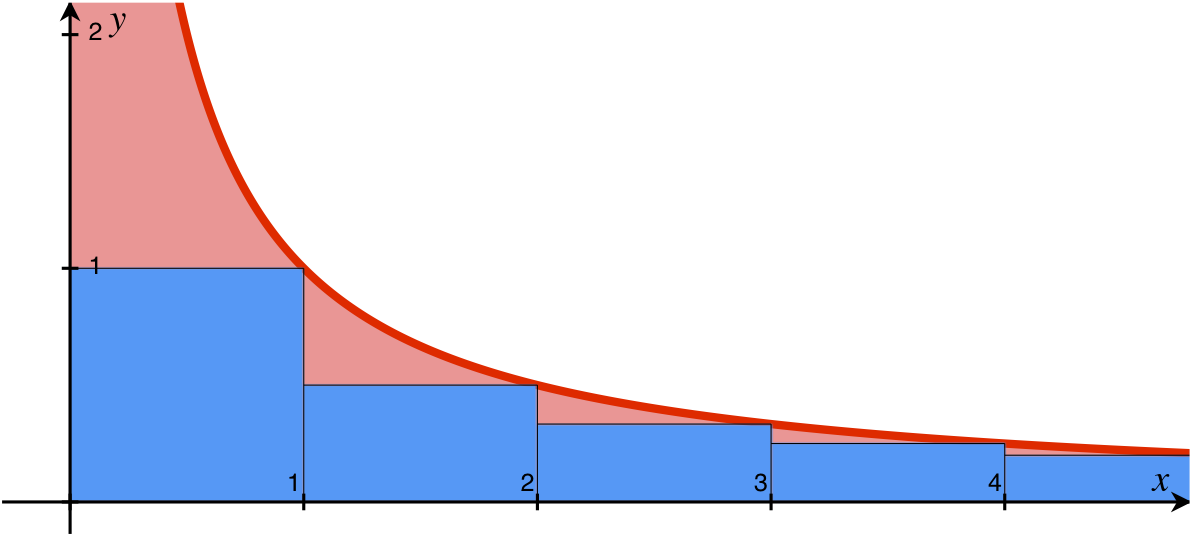
A definite integral is the limit of sums like this one as the rectangles get thinner. On the map, Riemann Sums & Definite Integral lists Polynomial Functions as a prerequisite, with Continuity and Antiderivatives as supporting topics. The Fundamental Theorem of Calculus then connects the two halves of the subject: it lists the Definition of the Derivative and Riemann sums as hard prerequisites. The integral lab tiles the area so you can watch the rectangles disappear into the curve.
The route to the chain rule
The public Chain Rule page shows the route to the topic. At the time of writing, the route is these ten topics, in this order, ending at the chain rule itself.
- Natural Numbers
- Variables & Constants
- Solving Linear Equations
- Function Notation & Composition
- Complex Numbers
- Basic Ratios
- Polynomial Functions
- Definition of the Derivative
- Differentiation Rules
- Chain Rule
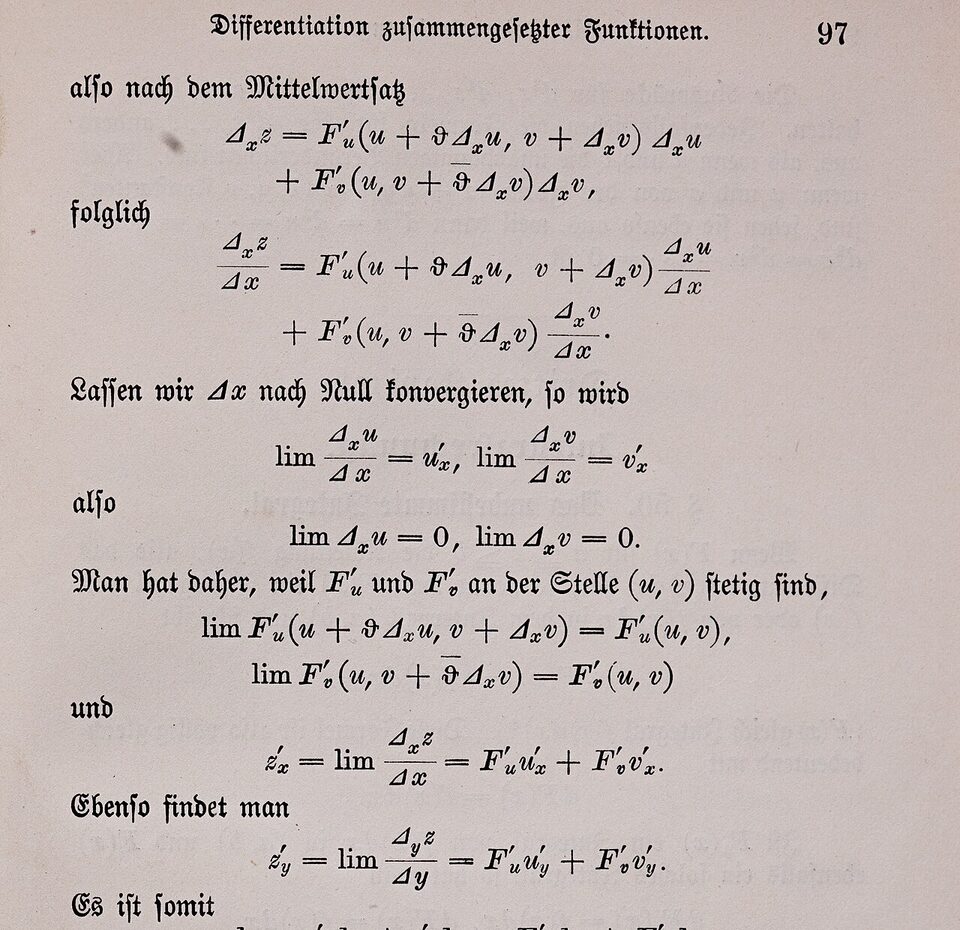
Read the list as a checklist. If a step feels unclear, go back to it before you continue. The chain rule also works for functions of several variables, and the page below comes from a German calculus text that derives that case.
How to check you are ready
Recognising a symbol is a weak test. A better one is whether you can use the idea on a problem you have not seen. Try these three, then go back to the matching topic and its route for any that you cannot do:
- Compose two functions. Given f and g, compute f(g(x)) and g(f(x)), and explain why they differ.
- Read the unit circle. Give sine and cosine at the standard angles without looking them up.
- Describe a polynomial. Find its zeros, its end behaviour and where its graph crosses the axes.
The About page says mastery on ManySpace is an estimate built from recorded study, practice and review evidence, and that it is not a qualification. Treat a passed check as a reason to move on, not as a certificate.
After Calculus I
On the map, Calculus II lists Calculus I as a mandatory prerequisite, and most of its mandatory links point back to it. Multivariable Calculus needs both courses. Probability depends mostly on Calculus II, so the calculus courses are the route into probability as well as into the AI track. For how calculus is used in machine learning, read what to learn before machine learning.
Frequently asked questions
Do I need precalculus before calculus?
On the ManySpace map, yes. Calculus I lists Precalculus as a mandatory prerequisite, and all 17 of its topics depend on Polynomial Functions, which is a precalculus topic.
Is algebra enough to start calculus?
Not on this map. Calculus I also needs Trigonometry, and Precalculus needs Algebra II and Trigonometry. Algebra covers the first part of the chain; trigonometry and precalculus complete it.
Do I need trigonometry for calculus?
Yes. Calculus I lists Trigonometry as a mandatory prerequisite, and the Derivatives of Transcendental Functions topic lists the Unit Circle. The unit circle lab shows the sine and cosine values as a point moves around the circle.
Which topics should I check before the chain rule?
Function Notation & Composition, Polynomial Functions, the Definition of the Derivative and Differentiation Rules. The Chain Rule topic page lists its full route.
What if I forget some algebra while I study calculus?
Go back along the route. The topic page lists the earlier topics in order, so study the one you cannot do on a problem, then return. In the app, reviews are scheduled with the FSRS memory model, so older topics come back when they are due.
How long does calculus take?
There is no fixed time. Topic pages show a study time estimate for each topic; read it as an estimate, as the site does.